
Umrah is a sacred pilgrimage to Makkah that allows Muslims to worship Allah, seek forgiveness, and strengthen their faith. If you are preparing for your first pilgrimage, learning how to perform Umrah step by step can help you understand the rituals and prepare for the journey with greater confidence.
This complete guide explains the main Umrah steps in order, including Ihram, Tawaf, Sa’i between Safa and Marwah, and shaving or trimming the hair. It also covers important duas, Ihram restrictions, guidance for men and women, a preparation checklist, and frequently asked questions.
You can also download the free illustrated Umrah guide PDF from HarmainGo to keep the instructions available during your journey.
What Is Umrah?
Umrah is an Islamic pilgrimage performed in Makkah at the Sacred Mosque, Masjid al-Haram. Unlike Hajj, which has specific dates and additional rites, Umrah can generally be performed at different times of the year, subject to current Saudi regulations and access arrangements.
The main sequence of Umrah consists of entering Ihram with the intention of performing Umrah, completing Tawaf around the Ka’bah, performing Sa’i between Safa and Marwah, and shaving or trimming the hair to complete the pilgrimage.
Some detailed religious rulings differ between Islamic schools of thought. If you have a special circumstance or are unsure about a particular ruling, consult a qualified scholar.
How to Perform Umrah Step by Step
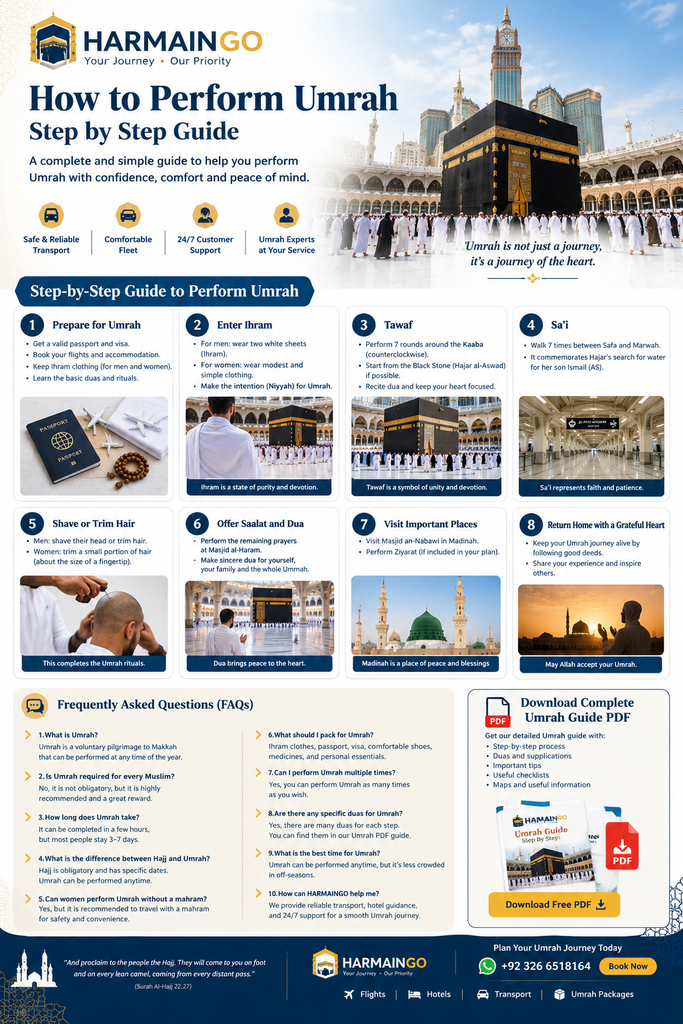
Step 1: Prepare Before Travelling
Before leaving for Saudi Arabia, check your passport, visa or entry requirements, any applicable permits, accommodation arrangements, and transport bookings.
Learn the location of the Miqat relevant to your route. Pilgrims travelling by air should prepare their Ihram clothing before reaching the Miqat because the aircraft may cross it before landing in Jeddah.
Pack essential medicines, personal hygiene items, comfortable footwear for travel, and the contact details for your accommodation and airport pickup.
Step 2: Prepare for Ihram
Before entering Ihram, a pilgrim may perform ghusl, a full ritual bath, and take care of personal grooming.
For men: Ihram clothing generally consists of two unstitched cloths, one wrapped around the lower body and the other covering the upper body. Men should observe the specific restrictions on clothing and head coverings during Ihram.
For women: Women wear their usual modest Islamic clothing. There is no requirement to wear a particular colour. Rules regarding face coverings and gloves should be followed according to the scholarly guidance they observe.
Ihram is not simply a type of clothing. It is a sacred state that begins with the intention to perform the pilgrimage and carries particular religious restrictions.
Step 3: Enter Ihram at the Miqat
A person intending to perform Umrah must enter Ihram at or before crossing the relevant Miqat.
Make the intention for Umrah in your heart and recite the Talbiyah:
Arabic transliteration:
Labbayka Allahumma labbayk, labbayka la shareeka laka labbayk. Innal-hamda wan-ni’mata laka wal-mulk, la shareeka lak.
Meaning:
Here I am, O Allah, here I am. You have no partner; here I am. Surely all praise, blessings and sovereignty belong to You. You have no partner.
Repeat the Talbiyah regularly during the journey until you begin Tawaf, following the guidance you trust.
After entering Ihram, observe its restrictions, including avoiding perfume and cutting hair or nails. Men must also follow the specific restrictions on ordinary fitted clothing and head coverings. If you accidentally violate a restriction, seek qualified religious advice rather than assuming a particular penalty applies.
Step 4: Enter Masjid al-Haram
When you reach Masjid al-Haram, enter respectfully and follow the mosque’s signs and staff instructions.
Keep your belongings secure, avoid blocking entrances, and be patient in crowded areas. You do not need to push through other pilgrims to reach a particular place.
Before beginning Tawaf, ensure you are prepared according to the purification requirements of the scholarly guidance you follow.
Step 5: Perform Tawaf Around the Ka’bah
Tawaf consists of seven circuits around the Ka’bah.
- Begin in line with the Black Stone.
- Keep the Ka’bah on your left.
- Walk around the Ka’bah in the counterclockwise direction.
- When you return to the Black Stone line, one circuit is complete.
- Continue until you have completed seven circuits.
If you can safely approach the Black Stone without pushing or harming anyone, follow the guidance for greeting it. If the area is crowded, simply gesture toward it from a distance and say “Allahu Akbar.”
There is no single mandatory dua for each Tawaf circuit. You may recite Qur’an, remember Allah, and make sincere personal supplications.
A commonly recited supplication between the Yemeni Corner and the Black Stone is:
Rabbana atina fid-dunya hasanatan wa fil-akhirati hasanatan wa qina adhaban-nar.
Meaning: Our Lord, grant us good in this world and good in the Hereafter, and protect us from the punishment of the Fire.
Step 6: Pray Two Rak’ahs After Tawaf
After completing seven circuits, cover your right shoulder if you had exposed it during Tawaf.
Pray two rak’ahs in an appropriate place if possible, traditionally near Maqam Ibrahim. If the area is crowded, you may pray elsewhere in the mosque without obstructing other worshippers.
Drink Zamzam water if available and convenient. Do not let crowd pressure or the desire to reach a particular spot put you or others at risk.
Step 7: Perform Sa’i Between Safa and Marwah
Sa’i commemorates Hajar’s search for water for her son, Ismail, peace be upon them.
Follow the signs to the Sa’i area and complete seven lengths between Safa and Marwah:
- Start at Safa and walk to Marwah: one length.
- Return from Marwah to Safa: two lengths.
- Continue alternating until seven lengths are complete.
- Finish at Marwah.
Men traditionally walk briskly or jog between the designated green lights where applicable, if physically able and safe to do so. Women walk normally. Pilgrims who need assistance should follow current accessibility arrangements and mosque staff instructions.
At Safa and Marwah, praise Allah and make dua. There is no requirement to recite a different fixed supplication for every length.
Step 8: Shave or Trim Your Hair
After completing Sa’i, the final step is to shave or trim the hair.
For men: Shaving the head or shortening the hair is accepted; shaving the whole head is commonly regarded as more virtuous.
For women: Women trim a small amount from the ends of their hair according to the scholarly guidance they follow.
After completing this step, Umrah is complete and the restrictions of Ihram are lifted.
Important Umrah Rules for Men and Women
While in Ihram, pilgrims must observe the applicable restrictions. These include avoiding perfume, not cutting hair or nails, and avoiding marital intimacy. Men must observe the rules concerning fitted clothing and head coverings. Women should follow the guidance on face coverings and gloves according to their school of thought.
If you experience menstruation, illness, an accidental mistake, or another circumstance that may affect your rites, seek advice from a qualified scholar or authorized religious guide. Do not rely on a general online article to decide whether a particular ritual is valid or whether compensation is required.
Umrah Preparation Checklist
Before travelling, make sure you have:
- Valid travel documents and the required entry arrangements.
- Checked the current official Saudi rules and any applicable permit requirements.
- Identified the correct Miqat for your route.
- Prepared Ihram clothing and personal essentials.
- Learned the sequence of Tawaf, Sa’i, and hair trimming.
- Saved your hotel address and emergency contacts.
- Confirmed your airport pickup and onward transport arrangements.
Planning Your Journey in Saudi Arabia with HarmainGo
Completing the religious rites is the priority of an Umrah journey. Good travel planning can also help pilgrims move between the airport, accommodation, Makkah, and Madinah with fewer logistical difficulties.
HarmainGo offers private transport planning for pilgrims travelling on routes such as Jeddah Airport to Makkah, Makkah to Madinah, and Madinah airport transfers, subject to booking confirmation and availability.
Before confirming a private Umrah taxi, check the vehicle type, passenger capacity, luggage allowance, pickup location, destination, and agreed fare. Families, older travellers, and groups may find a pre-arranged private transfer convenient when they prefer a direct journey.
Visit HarmainGo to explore transport options and contact the service about your journey.
Frequently Asked Questions About How to Perform Umrah
1. How do you perform Umrah step by step?
Enter Ihram at or before the Miqat, perform seven circuits of Tawaf, pray two rak’ahs if possible, complete seven lengths of Sa’i between Safa and Marwah, and shave or trim the hair.
2. What are the four main steps of Umrah?
The main sequence is Ihram, Tawaf, Sa’i, and shaving or trimming the hair. The details and classification of individual rites should be checked with a qualified scholar.
3. How long does it take to perform Umrah?
The rituals may take a few hours, but the time depends on crowd levels, prayer times, walking speed, accessibility needs, and waiting times.
4. Can Umrah be performed at any time of the year?
Umrah is generally performed throughout the year, subject to current Saudi regulations, seasonal arrangements, and access restrictions.
5. What is the Miqat for Umrah?
The Miqat is a designated boundary at which a pilgrim intending Umrah must enter Ihram before crossing it. The appropriate Miqat depends on the pilgrim’s route.
6. Can I wear Ihram on the plane?
You can put on the Ihram garments before boarding or during the flight, but you must enter the state of Ihram at or before crossing the relevant Miqat if you intend to perform Umrah. Prepare in advance and follow reliable guidance.
7. What dua should I recite when entering Ihram?
Recite the Talbiyah: “Labbayka Allahumma labbayk, labbayka la shareeka laka labbayk…” after making your intention for Umrah.
8. How many rounds are required for Tawaf?
Tawaf consists of seven circuits around the Ka’bah, beginning and ending at the Black Stone line.
9. Do I need to touch the Black Stone during Tawaf?
No. Do not push or harm others to reach it. If you cannot approach safely, gesture toward it from a distance.
10. Is wudu required for Tawaf?
This guide follows the widely taught view that wudu is required for Tawaf. Ask a qualified scholar about your circumstances or the ruling in the school of thought you follow.
11. What should I do after Tawaf?
Pray two rak’ahs in a suitable place if possible, without obstructing other worshippers. You may also drink Zamzam water if available.
12. How many rounds are there in Sa’i?
Sa’i has seven lengths between Safa and Marwah. Start at Safa and finish at Marwah.
13. Do women need to run during Sa’i?
Women generally walk normally. Men traditionally walk briskly or jog between the marked green lights where applicable, if safe and physically possible.
14. How do men finish Umrah?
After Sa’i, men shave the head or shorten their hair. Shaving the whole head is commonly considered more virtuous.
15. How do women finish Umrah?
Women trim a small amount from the ends of their hair, following the religious guidance they observe.
16. What should women wear during Ihram?
Women wear their usual modest Islamic clothing; no particular colour is required. They should follow the scholarly guidance they observe concerning face coverings and gloves.
17. Can elderly people perform Umrah?
Yes. Elderly pilgrims should plan rest breaks, consider accessibility needs, and use permitted mobility assistance where needed.
18. What happens if I make a mistake during Umrah?
The ruling depends on the mistake and the circumstances. Ask a qualified scholar or authorized religious guide promptly instead of guessing whether a penalty is required.
19. Is Umrah the same as Hajj?
No. Both are Islamic pilgrimages, but they have different requirements. Hajj has specific dates and additional rites.
20. Is visiting Madinah part of Umrah?
Visiting Madinah is not a condition for completing Umrah. Many pilgrims visit Al-Masjid an-Nabawi as part of their wider journey.
21. Should I book a taxi before arriving in Saudi Arabia?
Advance booking can help with airport pickup and onward travel, particularly for families and groups. Confirm the fare, vehicle, pickup details, and availability directly with the provider.
22. Does HarmainGo perform the Umrah rituals?
No. HarmainGo provides transport services. Pilgrims perform their own religious rites and should consult a qualified religious guide for questions about worship.
23. Where can I find official Umrah guidance?
Consult the Saudi Ministry of Hajj and Umrah’s official awareness guides and the official Nusuk Umrah Journey.
May Allah accept your Umrah, make your journey safe, and grant you ease and blessings throughout your pilgrimage.