
Makkah is the spiritual centre of Islam and a destination that millions of Muslims visit for Hajj and Umrah. Beyond Masjid Al Haram, the city and its surrounding areas contain historic mosques, mountains, valleys and landmarks connected with Islamic history. Exploring these locations can help pilgrims understand the events and places they have learned about throughout their lives.
If you are searching for Makkah Ziyarat Places, this guide explains 12 notable locations, their historical significance, practical visitor considerations and how to plan a comfortable sightseeing journey. It also explains which locations may require walking or climbing, so families can choose a realistic itinerary before leaving their hotel.
Ziyarat is a visit for remembrance, reflection and learning. Visiting these locations is not a required step of Umrah, and travellers should not feel that they must visit every site to complete their pilgrimage.
Quick Answer: What Are the Main Makkah Ziyarat Places?
The main places commonly included in a Makkah Ziyarat itinerary are Jabal Al Noor and Cave Hira, Jabal Thawr, Jannat Al Mu’alla, Masjid Al Jinn, Masjid Aisha in Al Taneem, Mina, Muzdalifah, Arafat, Jabal Al Rahmah, Masjid Namirah, the Jamarat Bridge area and the Hira Cultural District.
Some locations are suitable for a short stop, while others involve substantial walking, climbing or travel between different parts of Makkah. Access to particular sites can also vary according to local arrangements, construction, crowd management and the Hajj season.
1. Jabal Al Noor and Cave Hira
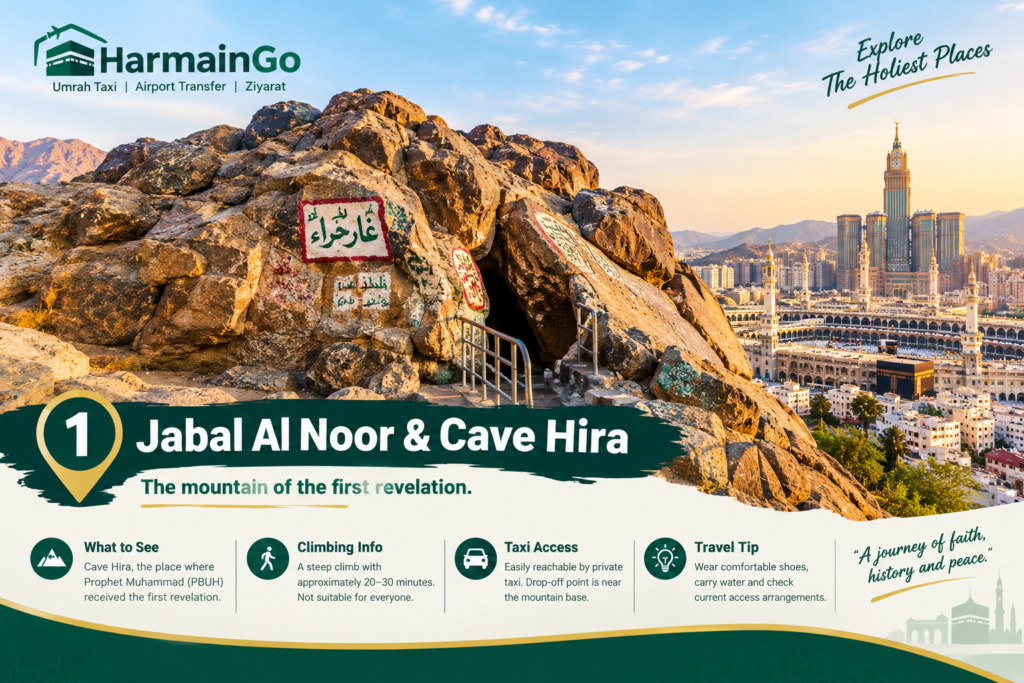
Jabal Al Noor, commonly translated as the Mountain of Light, is one of the best-known historic landmarks associated with Makkah. Cave Hira is located on this mountain and is associated with the first revelation received by Prophet Muhammad (peace be upon him).
For many pilgrims, learning about Cave Hira is an opportunity to reflect on the beginning of the prophetic mission and the importance of seeking knowledge.
What should visitors know?
- Reaching the cave requires a steep mountain climb.
- The ascent and descent can be physically demanding.
- Visitors should carry water, wear suitable footwear and assess their fitness before attempting the climb.
- Older visitors and people who may struggle with steep terrain can consider viewing the mountain from a suitable accessible location instead.
A taxi can help you reach the surrounding area, but it does not eliminate the climb to the cave itself. Confirm the designated drop-off and access arrangements before travelling.
2. Jabal Thawr and Cave Thawr
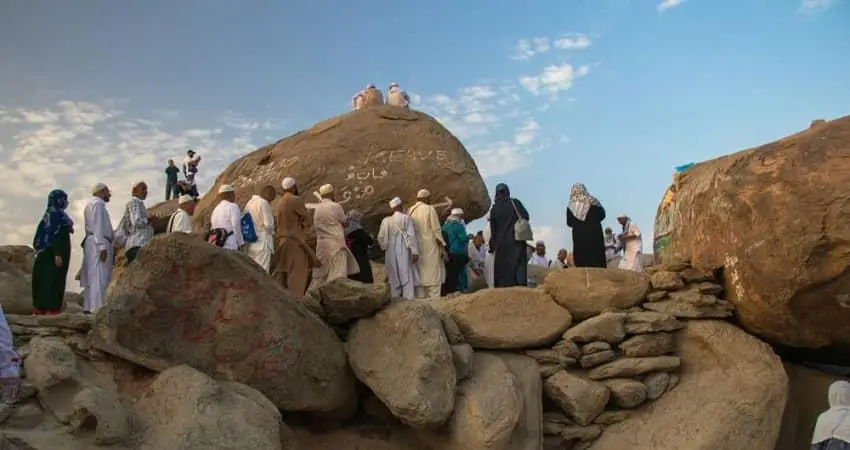
Jabal Thawr is another historically significant mountain near Makkah. Cave Thawr is associated with the Hijrah, when Prophet Muhammad (peace be upon him) and Abu Bakr (may Allah be pleased with him) took refuge there during their migration from Makkah to Madinah.
The location is remembered for its connection with trust in Allah, patience and the events surrounding the migration.
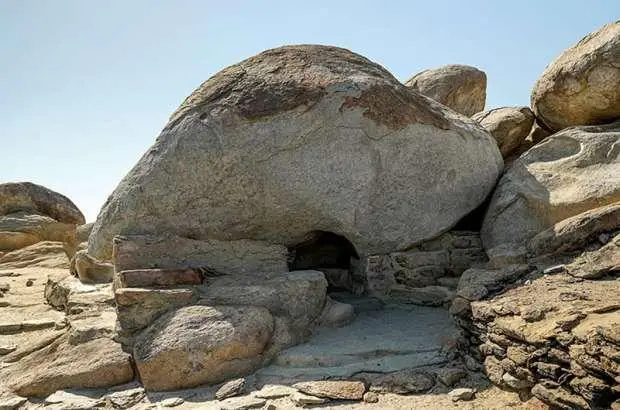
The mountain climb is steep and demanding. It should not be treated as an easy sightseeing stop, particularly for families travelling with young children or older relatives.
If your group prefers not to climb, you can ask your driver about a suitable viewing point and spend time learning about the site’s history without attempting the ascent.
3. Jannat Al Mu’alla Cemetery
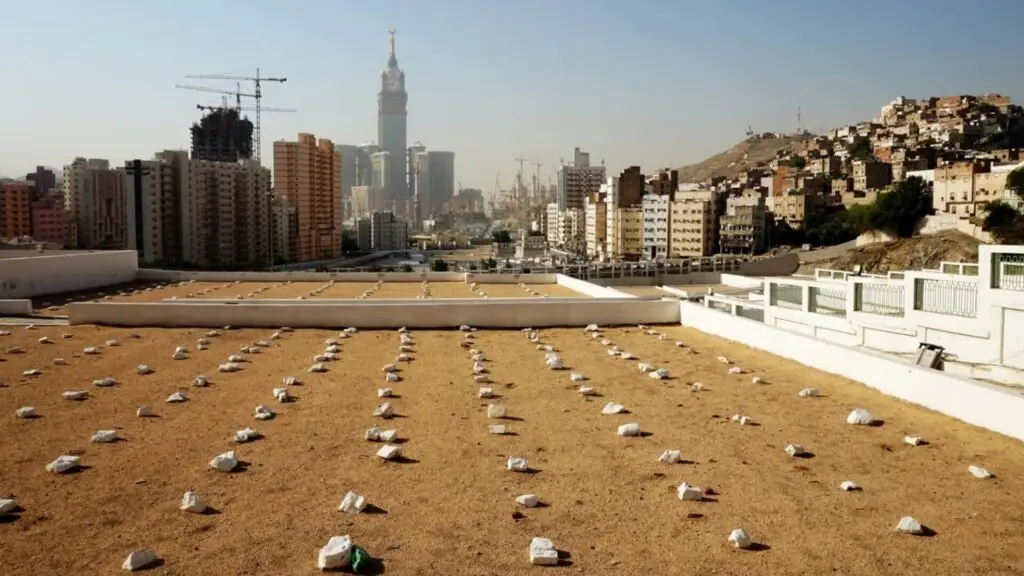
Jannat Al Mu’alla is a historic cemetery in Makkah associated with early Muslim history. It is traditionally associated with the burial of several members of the Prophet’s family and other important figures from the early Muslim community.
Visitors interested in Islamic history may wish to learn about the cemetery and its historical significance before visiting.
Visitor guidance: Follow local cemetery rules, respect the site and other visitors, and verify access arrangements before travelling. Do not assume that every area will be open to visitors at all times.
4. Masjid Al Jinn
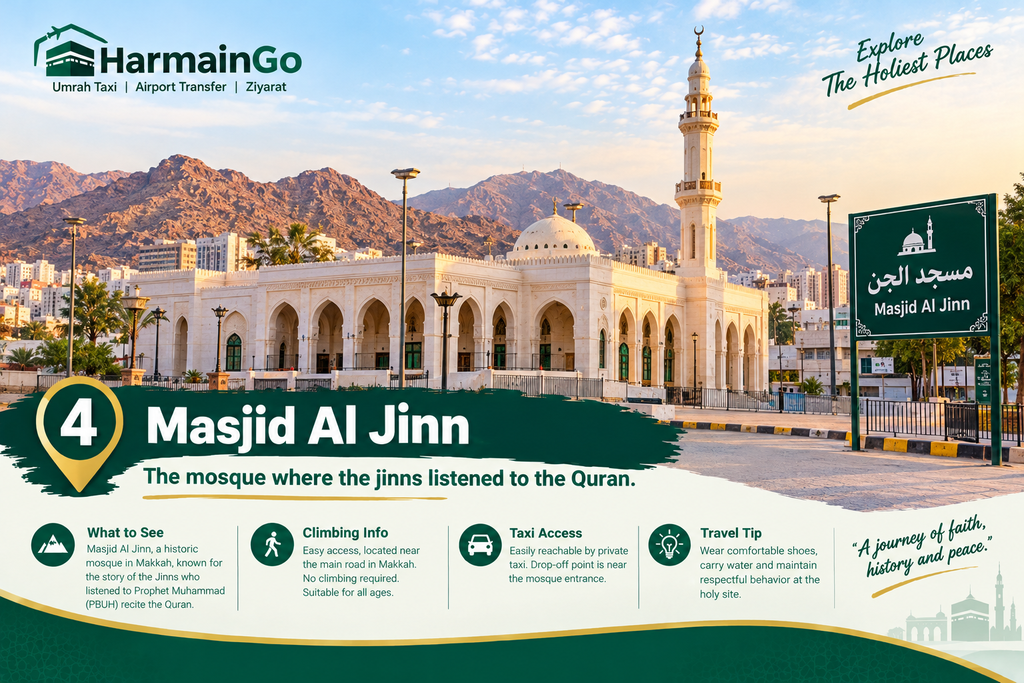
Masjid Al Jinn is a well-known mosque in Makkah connected with Islamic tradition concerning the jinn who listened to the Quran. Its name and historical associations make it a location frequently mentioned in local Ziyarat itineraries.
The mosque is generally considered a short-stop location compared with the mountain sites. Visitors should check current access and prayer arrangements, particularly during busy periods.
As with other religious sites, the most meaningful approach is to understand the history and significance of the place rather than treating the visit as a requirement of Umrah.
5. Masjid Aisha in Al Taneem
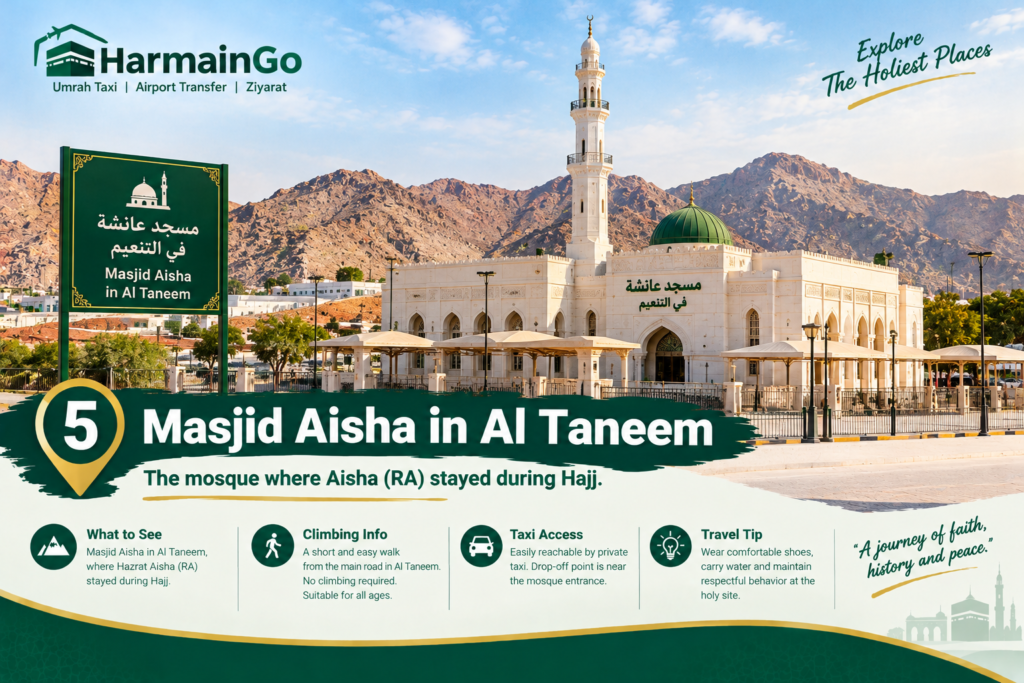
Masjid Aisha, also known as Masjid Al Taneem, is an important mosque associated with entering Ihram for Umrah for people who need to go outside the Haram boundary for that purpose.
Some visitors include the mosque in a Makkah sightseeing itinerary because of its connection with Umrah arrangements.
However, visiting this mosque is not necessary for every pilgrim. Whether you need to travel there depends on your circumstances and the religious guidance applicable to your situation.
Before travelling, confirm your intended purpose with a knowledgeable religious guide if you are unsure about Ihram requirements.
6. Mina
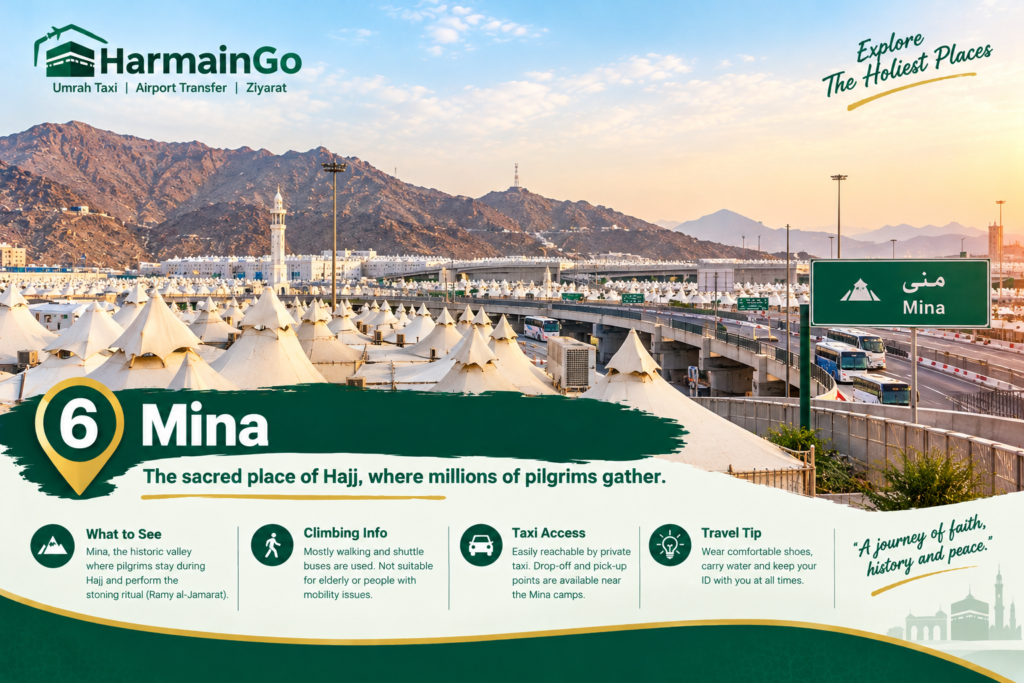
Mina is a major site of the Hajj pilgrimage, located east of central Makkah. The valley is known for its extensive tent facilities and the role it plays in the Hajj rituals.
For visitors outside Hajj, seeing Mina can provide a better understanding of the scale of the annual pilgrimage and the facilities developed to accommodate pilgrims.
Access and movement can be restricted during Hajj and other crowd-management periods. A visit outside the Hajj season may have different arrangements, so check local instructions before planning your stop.
7. Muzdalifah
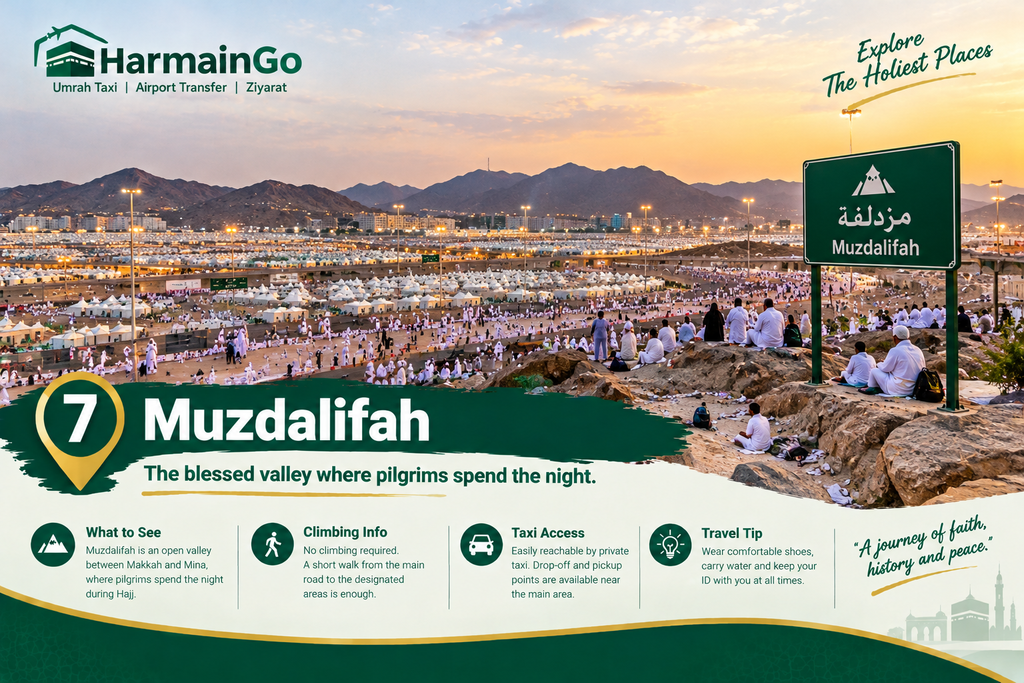
Muzdalifah is an open area between Mina and Arafat that plays an important role in the Hajj pilgrimage. Pilgrims traditionally spend part of the Hajj journey there according to the prescribed rites.
For Umrah visitors who are exploring Islamic historical locations, a stop at Muzdalifah can help explain how the different Hajj locations fit together geographically.
Muzdalifah is an expansive area rather than a conventional indoor tourist attraction. Plan your visit around the weather, travel conditions and any applicable access restrictions.
8. Arafat and Jabal Al Rahmah
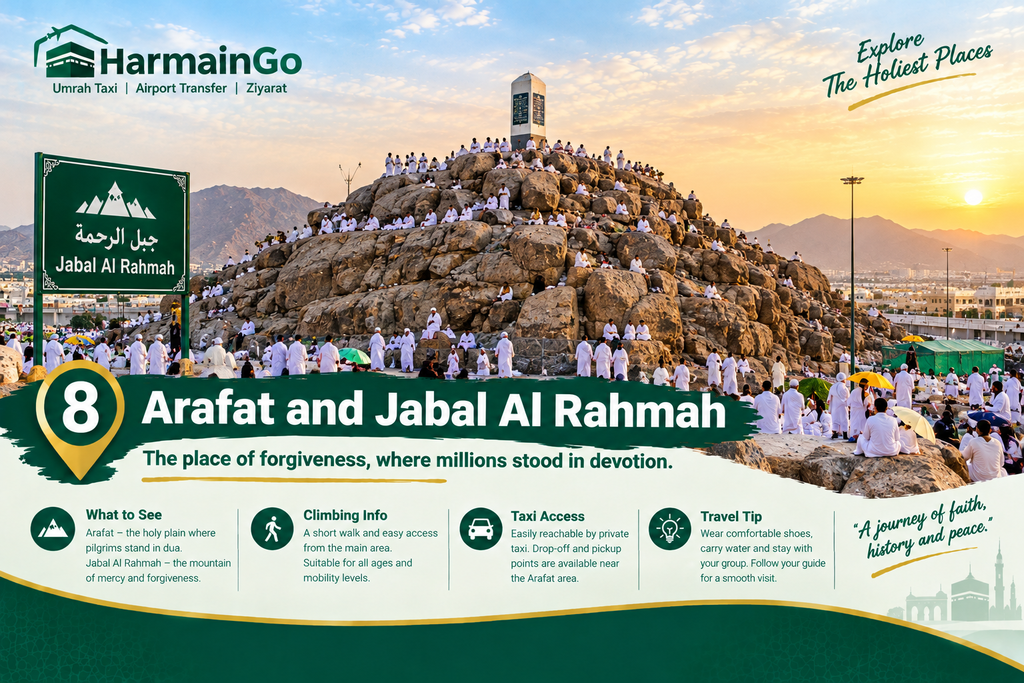
Arafat is one of the most significant locations in the Hajj pilgrimage. The standing at Arafat on the ninth day of Dhul Hijjah is a central rite of Hajj.
Jabal Al Rahmah, often called the Mount of Mercy, is a recognised landmark within the plain of Arafat. Many visitors include it in a wider journey through the Hajj sites.
Keep in mind that a sightseeing visit outside Hajj is not the same as performing the prescribed Hajj rites.
If you plan to visit Jabal Al Rahmah, wear comfortable shoes and consider the heat, available shade and the amount of walking required. Do not assume that climbing the hill is a required religious act.
9. Masjid Namirah
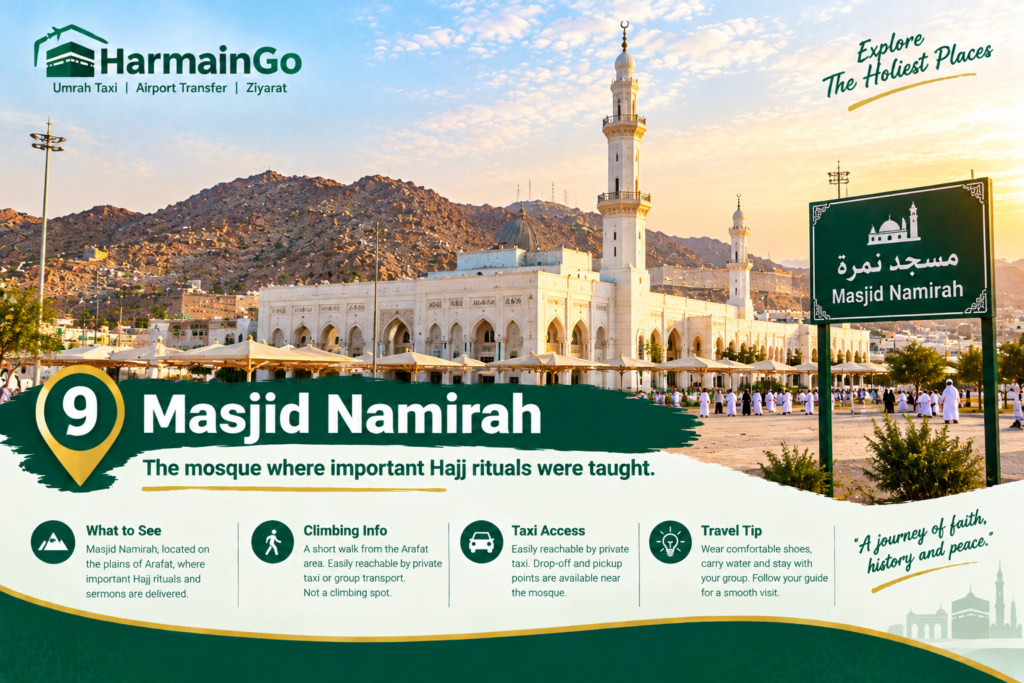
Masjid Namirah is a major mosque in the Arafat area, associated with the Hajj pilgrimage and the sermon delivered during the standing at Arafat.
The mosque is particularly important in the context of Hajj, when arrangements and access are closely connected to the pilgrimage schedule.
If you are visiting outside Hajj, verify the mosque’s current visitor access and prayer arrangements. During Hajj, access and surrounding roads may be controlled, so an ordinary sightseeing itinerary may not be possible.
10. Jamarat Bridge Area
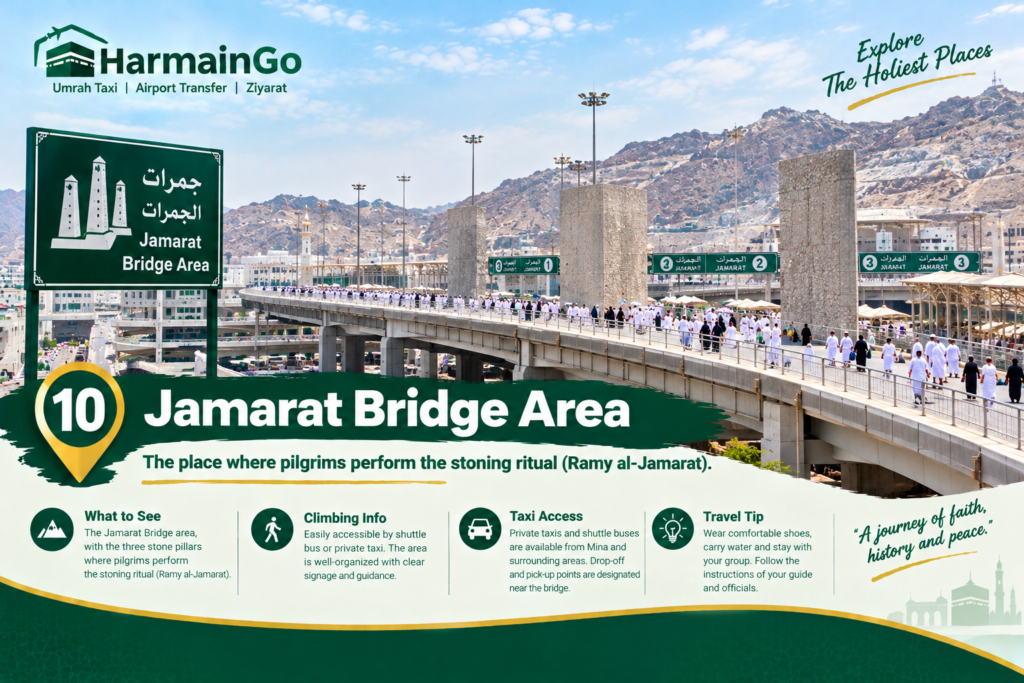
The Jamarat Bridge is located in Mina and is associated with the stoning ritual performed during Hajj. Its multi-level structure forms part of the infrastructure developed to manage large numbers of pilgrims safely.
Visitors interested in the logistics of Hajj may find the area informative, particularly when learning how the pilgrimage sites are connected.
The Jamarat area is subject to strict crowd-management arrangements. Do not plan an independent visit during restricted periods or assume that normal sightseeing access is available.
11. Hira Cultural District
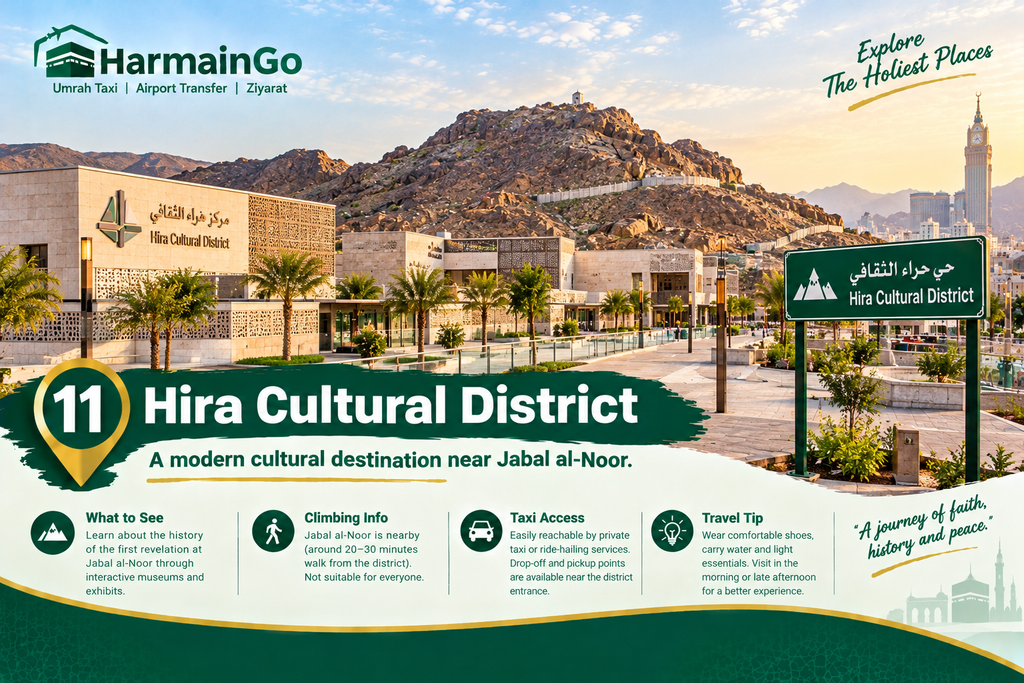
The Hira Cultural District is a visitor-oriented destination associated with the history of Jabal Al Noor and Cave Hira. The wider area provides opportunities to explore the historical and cultural context of the mountain.
Depending on current opening arrangements, visitors may be able to explore cultural exhibitions and educational facilities in the district.
This can be a useful alternative for travellers who want to learn about the first revelation but do not wish to attempt the mountain climb.
Before visiting, check official destination information for opening hours, ticketing requirements, exhibition availability and access details.
12. The Birthplace Area of Prophet Muhammad (Peace Be Upon Him)
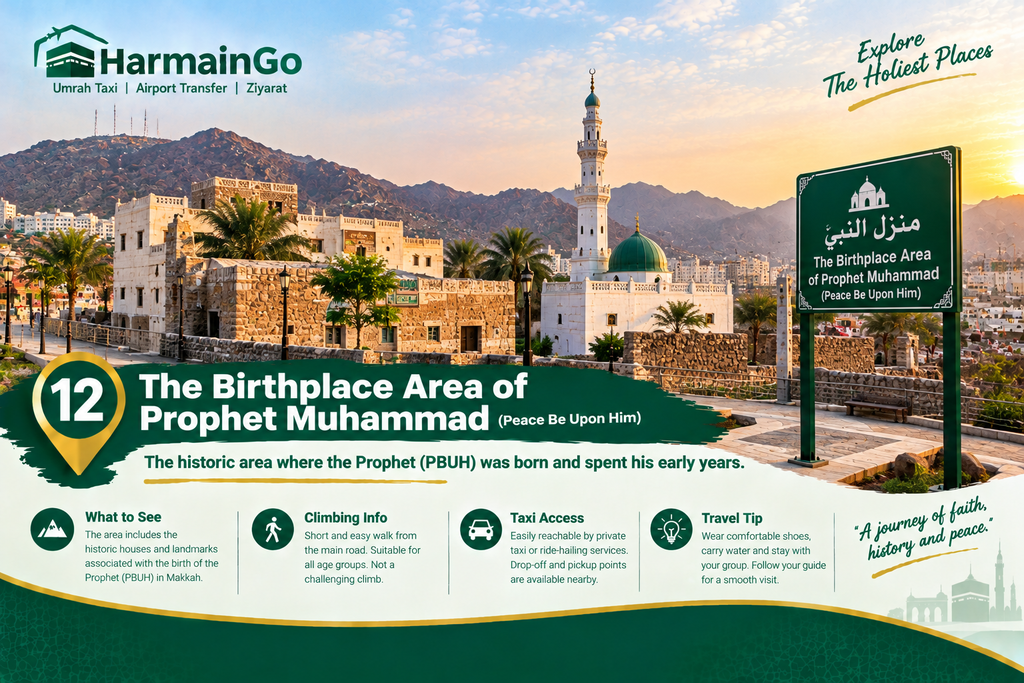
The area traditionally associated with the birthplace of Prophet Muhammad (peace be upon him) is another location mentioned in Makkah historical guides. The area has undergone changes over time and is not necessarily a conventional visitor attraction.
Travellers should distinguish between a site’s traditional historical association and its present-day use or accessibility. Do not assume that the exact location is open for entry or that a dedicated religious visit is required.
If this location interests you, consult reliable historical sources and confirm the current situation locally before including it in your route.
How to Plan a Makkah Ziyarat Tour
A good itinerary considers the locations you want to see, the physical abilities of your group, traffic conditions and the time available. Trying to visit every location in one trip can make the experience tiring, especially if your itinerary includes mountain climbs.
Step 1: Choose the locations that matter most to you
Start by selecting the historic sites you genuinely want to learn about. For example, you may prefer a short tour of accessible landmarks, or a longer trip covering several Hajj-related locations.
Step 2: Check walking requirements
Jabal Al Noor and Jabal Thawr involve strenuous climbs. They should not be grouped into a supposedly easy itinerary without accounting for the time and energy required.
For older relatives or people with limited mobility, prioritise accessible stops and ask about suitable viewing locations.
Step 3: Group locations sensibly
A practical plan groups sites by area rather than repeatedly travelling across the city. Your driver can help arrange the order according to your hotel location, road conditions and current access instructions.
A route may include some northern Makkah landmarks and then a separate journey towards Mina and Arafat, depending on the sites selected.
Step 4: Confirm transport and waiting arrangements
Before booking, ask whether the price covers a private vehicle, how long the driver will wait, which stops are included and whether any extra charges apply.
A private vehicle can be particularly convenient for families who want flexibility. The best choice depends on the number of passengers, luggage and the amount of walking planned.
Step 5: Plan around the weather and prayer times
Makkah can be extremely hot, particularly during warmer months. Start outdoor visits at a suitable time, carry water and follow local safety guidance.
Prayer times, traffic and crowd-management arrangements can also affect the schedule, so allow room for changes.
Private Taxi for Makkah Ziyarat: Is It Worth It?
A private taxi offers door-to-door transport between selected locations without requiring you to coordinate multiple separate rides. It can be convenient for families, small groups and travellers who prefer a flexible schedule.
Before booking a Makkah Ziyarat taxi, compare:
- Vehicle capacity: Make sure there is suitable seating for everyone.
- Luggage space: Choose a vehicle based on your actual luggage requirements.
- Stops included: Confirm the exact itinerary rather than relying on a general tour description.
- Waiting time: Ask how long the driver will wait at each stop.
- Total price: Confirm whether the quoted fare covers the complete route and whether any additional charges may apply.
- Accessibility: Tell the provider if anyone in your group needs assistance with walking or boarding the vehicle.
Harmain Go provides private transport booking options for pilgrims planning journeys around Makkah. You can explore the available options on the Makkah Ziyarat Taxi Service page. Confirm the current vehicle availability, fare and itinerary before making a booking.
Frequently Asked Questions About Makkah Ziyarat Places
What are the most important Makkah Ziyarat places?
Commonly visited locations include Jabal Al Noor, Cave Hira, Jabal Thawr, Jannat Al Mu’alla, Masjid Al Jinn, Masjid Aisha, Mina, Muzdalifah and Arafat. The best itinerary depends on your interests, available time and physical ability.
How long does a Makkah Ziyarat tour take?
The duration depends on the number of locations, traffic, access arrangements and whether you intend to climb either mountain. A short tour of selected sites may take less time than a wider itinerary covering Mina and Arafat. Ask your transport provider for a realistic estimate based on your chosen stops.
Can elderly pilgrims visit Makkah Ziyarat places?
Yes, many locations can be viewed without climbing a mountain, but accessibility varies. Jabal Al Noor and Jabal Thawr require strenuous climbing to reach their caves. Elderly visitors should choose stops according to their mobility and seek medical advice when appropriate.
Is Ziyarat compulsory during Umrah?
No. Visiting these historic locations is not a required part of the Umrah rituals. Pilgrims can complete Umrah without visiting additional Ziyarat sites.
Can I book a private taxi for Makkah Ziyarat in advance?
You can contact a private transport provider before your trip to discuss your preferred route, vehicle, pickup location and schedule. Confirm the fare, waiting time and any applicable restrictions before finalising the booking.
Are all Makkah Ziyarat places open every day?
No. Access can vary according to the location, opening hours, construction, security arrangements, crowd management and the Hajj season. Verify current information before setting out.
Frequently Asked Questions About Makkah Ziyarat Places
1. What are the most famous Makkah Ziyarat places?
Some well-known Makkah Ziyarat places include Jabal Al Noor, Cave Hira, Jabal Thawr, Jannat Al Mu’alla, Masjid Al Jinn, Mina, Muzdalifah, Arafat, and Jabal Al Rahmah. Visitors should check local access conditions before planning their visit.
2. How many Ziyarat places are there in Makkah?
There are several religious, historical, and cultural sites in and around Makkah. The number depends on whether you include mosques, mountains, Hajj locations, cemeteries, and newer cultural attractions.
3. What is the best way to visit Makkah Ziyarat places?
The best approach is to group nearby locations into a practical itinerary, allow sufficient time at each stop, and check access conditions in advance. A private taxi can provide flexible transportation between selected sites.
4. Can I visit Makkah Ziyarat places during Umrah?
Yes, visitors can plan Ziyarat during their Umrah trip if time, health, and local arrangements allow. Ziyarat sightseeing is separate from the essential rituals of Umrah, so pilgrims should prioritise their worship and rest.
5. Which Makkah Ziyarat places are suitable for elderly visitors?
Mosques and accessible viewpoints may be more suitable than steep mountain climbs, depending on current access and mobility arrangements. Jabal Al Noor and Jabal Thawr involve strenuous uphill walking and may not be appropriate for every elderly visitor.
6. Is Jabal Al Noor the same as Cave Hira?
No. Jabal Al Noor is the mountain, while Cave Hira is the cave located on the mountain. The cave is widely associated with the first revelation received by Prophet Muhammad (peace be upon him).
7. Why is Jabal Al Noor important for Muslims?
Jabal Al Noor is historically significant because Cave Hira is associated with the beginning of the revelation to Prophet Muhammad (peace be upon him). Visitors should approach the site respectfully and understand that the climb is physically demanding.
8. How difficult is the climb to Cave Hira?
The climb to Cave Hira is steep and can be tiring, particularly in hot weather. Difficulty varies according to fitness, health, crowd conditions, and the route available. Carry water, wear suitable footwear, and do not attempt the climb if it is unsafe for you.
9. Can I visit Jabal Al Noor without climbing to Cave Hira?
You may be able to view the mountain from surrounding areas without completing the climb. Whether you can approach particular areas depends on current access arrangements. Check local guidance before travelling.
10. What is the difference between Jabal Al Noor and Jabal Thawr?
Jabal Al Noor is associated with Cave Hira and the first revelation. Jabal Thawr is associated with the cave where Prophet Muhammad (peace be upon him) and Abu Bakr (may Allah be pleased with him) sought shelter during the Hijrah journey.
11. Why is Jabal Thawr important in Islamic history?
Jabal Thawr is associated with the Hijrah from Makkah to Madinah. The cave on the mountain is remembered in accounts of the journey of Prophet Muhammad (peace be upon him) and Abu Bakr (may Allah be pleased with him).
12. Is climbing Jabal Thawr necessary during Makkah Ziyarat?
No. Climbing Jabal Thawr is not a required part of Umrah or Hajj. Visitors can learn about its historical significance without undertaking the difficult climb.
13. What is Jannat Al Mu’alla in Makkah?
Jannat Al Mu’alla is a historic cemetery in Makkah. It is associated with members of the early Muslim community and holds historical importance for many visitors. Access and visiting arrangements should be confirmed locally.
14. Can visitors enter Jannat Al Mu’alla?
Access rules may vary, and visitors should follow current local instructions. Do not assume that entry into the cemetery is permitted at all times or for every visitor.
15. What is the historical significance of Masjid Al Jinn?
Masjid Al Jinn is a historic mosque in Makkah associated with Islamic tradition concerning the jinn listening to the Quran. Visitors can learn about its significance while respecting mosque etiquette and current access arrangements.
16. What is Masjid Aisha in Makkah?
Masjid Aisha, also known as Masjid Al Taneem, is a mosque outside the central Haram area commonly used by pilgrims who need to enter Ihram for another Umrah. Visitors should confirm their own religious requirements with a qualified scholar or their group guide.
17. Is Masjid Aisha a Makkah Ziyarat place?
Yes, Masjid Aisha is often included in Makkah sightseeing and pilgrimage itineraries. It is particularly relevant to pilgrims planning another Umrah, although individual circumstances and religious guidance may differ.
18. What are Mina and Muzdalifah known for?
Mina and Muzdalifah are important locations associated with Hajj. Mina is connected with the stoning ritual and other Hajj activities, while Muzdalifah is associated with the pilgrims’ stay during a designated part of Hajj.
19. Can tourists visit Mina outside the Hajj season?
Access and movement arrangements may differ throughout the year, especially during Hajj preparations and the pilgrimage period. Check current local regulations before planning a visit outside the Hajj season.
20. Why is Arafat important during Hajj?
Arafat is central to Hajj because standing at Arafat on the designated day is a fundamental part of the pilgrimage. The plain and surrounding landmarks are historically and religiously significant to Muslims.
21. What is Jabal Al Rahmah in Arafat?
Jabal Al Rahmah is a hill in the Arafat area that many visitors recognise as a landmark during Hajj-related trips. Visitors should distinguish established religious requirements from local customs and avoid assuming that climbing the hill is obligatory.
22. Is Masjid Namirah located in Arafat?
Masjid Namirah is located in the Arafat area and is associated with the Hajj sermon and prayer arrangements. Access, capacity, and permitted movement can change during the pilgrimage season.
23. What is the Jamarat Bridge in Mina?
The Jamarat Bridge is a major structure used by pilgrims during the stoning ritual of Hajj. It is an important part of the Hajj infrastructure, but access may be restricted outside authorised arrangements and designated periods.
24. What can visitors learn at the Hira Cultural District?
The Hira Cultural District offers cultural and historical experiences connected with the area of Jabal Al Noor. Check official visitor information for current exhibitions, opening times, ticketing, and access before travelling.
25. Is the Prophet Muhammad’s birthplace area open to visitors?
The area traditionally associated with the birthplace of Prophet Muhammad (peace be upon him) is of historical interest. The availability of access to a particular building or site can vary, so visitors should verify current arrangements and avoid assuming it operates as a conventional visitor attraction.
26. How long does a Makkah Ziyarat tour take?
The duration depends on the number of places selected, traffic, walking requirements, and access restrictions. A short tour covering a few nearby sites may take less time than a broader itinerary that includes mountain areas and Hajj landmarks.
27. Can I visit all Makkah Ziyarat places in one day?
It may be possible to visit several selected sites in one day, but covering every historical location can be rushed or impractical. Choose priorities, allow time for prayer and rest, and avoid strenuous climbs if your schedule or health does not permit them.
28. What is the best time of day for Makkah Ziyarat?
The best time depends on weather, crowd levels, the location, and local opening or access arrangements. Cooler hours may make outdoor sightseeing more comfortable, but always check conditions before starting a mountain walk.
29. Is a private taxi useful for Makkah Ziyarat?
A private taxi can help visitors travel between selected Ziyarat locations without arranging separate transport at each stop. Before booking, confirm the route, total fare, waiting time, passenger capacity, and whether the driver can reach each intended drop-off point.
30. How do I book a private taxi for Makkah Ziyarat?
Contact your chosen transport provider with your hotel or pickup point, preferred date, number of passengers, and the locations you want to visit. Ask for the total fare and included waiting time before confirming. You can contact Harmain Go to enquire about private transport for your planned itinerary.
31. Is the Makkah Ziyarat taxi fare fixed?
Taxi fares depend on the provider, itinerary, vehicle type, duration, and waiting arrangements. Request a written or message-based quote that explains what is included, and confirm the price before the journey begins.
32. Which vehicle is best for a Makkah Ziyarat tour?
A sedan may suit a small group with light luggage, while a van or larger vehicle may be more practical for families and groups. Choose based on passenger capacity, comfort, mobility needs, and luggage rather than price alone.
33. Can families with children take a Makkah Ziyarat taxi tour?
Families can plan a private sightseeing trip with suitable breaks and a vehicle that meets their needs. Confirm child-seat availability where required, keep children supervised near roads and crowded areas, and avoid difficult climbs if they are unsuitable.
34. Is Makkah Ziyarat suitable for wheelchair users?
Suitability depends on the individual site, surface conditions, ramps, distance from the drop-off point, and current accessibility arrangements. Mountain climbs are generally not suitable for wheelchair access. Confirm accessibility at each planned stop before travelling.
35. What should I wear for Makkah Ziyarat?
Wear modest, comfortable clothing appropriate for the local environment. For outdoor locations, use sturdy footwear, sun protection, and clothing suited to the weather. Follow the rules and etiquette of mosques and other religious sites.
36. What should I carry on a Makkah Ziyarat trip?
Useful items may include drinking water, comfortable footwear, sun protection, a charged phone, essential medication, and identification. Carry only what you need and follow local guidance regarding restricted items and site entry.
37. Are all Makkah Ziyarat places open every day?
No. Opening times, entry arrangements, and access restrictions can vary by location, season, security conditions, and official instructions. Check current information before setting out, particularly for Hajj-related areas and cultural attractions.
38. Can I take photographs at Makkah Ziyarat places?
Photography rules depend on the specific location and current instructions. Respect worshippers’ privacy, follow posted restrictions, and avoid photographing people without permission. Do not block pathways or disturb religious activities to take pictures.
39. What is the difference between Makkah Ziyarat and Hajj rituals?
Makkah Ziyarat generally refers to visiting religious, historical, and cultural sites. Hajj rituals are specific acts of worship performed according to prescribed rules and timings. Visiting a historical site does not automatically make it part of the required Hajj or Umrah rituals.
40. Are Makkah Ziyarat places mentioned in the Quran?
Some locations are connected with events discussed in Islamic scripture or historical traditions, but not every modern landmark is directly named in the Quran. For religious details, consult reliable Islamic scholarship and distinguish Quranic references from later historical accounts.
41. Can I arrange Makkah Ziyarat from a hotel near Masjid al-Haram?
You can ask a transport provider to arrange pickup from your hotel or a nearby permitted meeting point. Vehicle access near the Haram can be affected by traffic management and restrictions, so confirm the exact pickup and drop-off arrangements in advance.
42. Can I combine Makkah Ziyarat with a Jeddah airport transfer?
Some transport providers may offer combined journeys, depending on your flight schedule, pickup point, itinerary, and availability. Confirm the route and total price in advance, and leave sufficient time for airport procedures and travel.
43. Should I visit Makkah Ziyarat places before or after Umrah?
There is no universal sightseeing schedule that suits every pilgrim. Many visitors prioritise their Umrah, rest, and prayer before arranging optional sightseeing. Choose a time that fits your health, travel schedule, and group needs.
44. Are Makkah Ziyarat places suitable for senior citizens travelling in groups?
Some sites may be suitable with careful planning, while steep mountains and long walks may be too demanding. Select accessible locations, plan rest stops, arrange appropriate transport, and consider the needs of every traveller in the group.
45. How can I plan a respectful and comfortable Makkah Ziyarat itinerary?
Choose locations according to their historical interest and accessibility, verify current site rules, dress appropriately, and allow enough time for travel and rest. Avoid treating optional sightseeing as a religious obligation, and follow official instructions throughout your visit.
46. Where can I check official information about Makkah landmarks?
Use official visitor resources such as the Discover Makkah website to research landmarks, cultural attractions, and trip-planning information. Verify current details before visiting because access, opening times, and local arrangements may change.
47. Does Harmain Go provide private transport for Makkah Ziyarat?
Harmain Go is a private Umrah and taxi transport brand. Contact the team directly to confirm current availability, the locations covered, vehicle options, and the price for your requested Makkah Ziyarat itinerary.
48. How can I compare different Makkah Ziyarat transport options?
Compare the total fare, pickup convenience, vehicle size, waiting time, flexibility, and accessibility for your chosen sites. Ask providers to confirm the complete itinerary and any additional charges before booking.
49. Is it safe to climb Makkah’s historic mountains during hot weather?
Mountain climbs can be physically demanding, and heat can increase the risk of dehydration and heat-related illness. Check weather conditions, carry water, avoid climbing when conditions are unsafe, and stop if you feel unwell.
50. How can I make my Makkah Ziyarat trip more meaningful?
Learn the historical context of each location before visiting, follow respectful behaviour, and leave time for reflection rather than rushing between stops. Reliable historical sources and qualified religious guidance can help you understand the difference between established teachings and local customs.
Final Thoughts
Exploring Makkah’s historic landmarks can make your visit more informative and help you understand the places associated with Islamic history and the Hajj pilgrimage. The most suitable itinerary is not necessarily the one that includes the most stops; it is the one that fits your time, comfort, interests and physical ability.
Plan your selected locations in advance, verify access arrangements, take appropriate precautions in hot weather and choose transport that suits your group. If you prefer a flexible door-to-door journey, explore Harmain Go’s private transport options and confirm the details before travelling.
Further Reading
For current destination information, consult Discover Makkah’s official landmarks guide and its interactive map. These resources can help you verify locations and discover additional cultural attractions before finalising your itinerary.